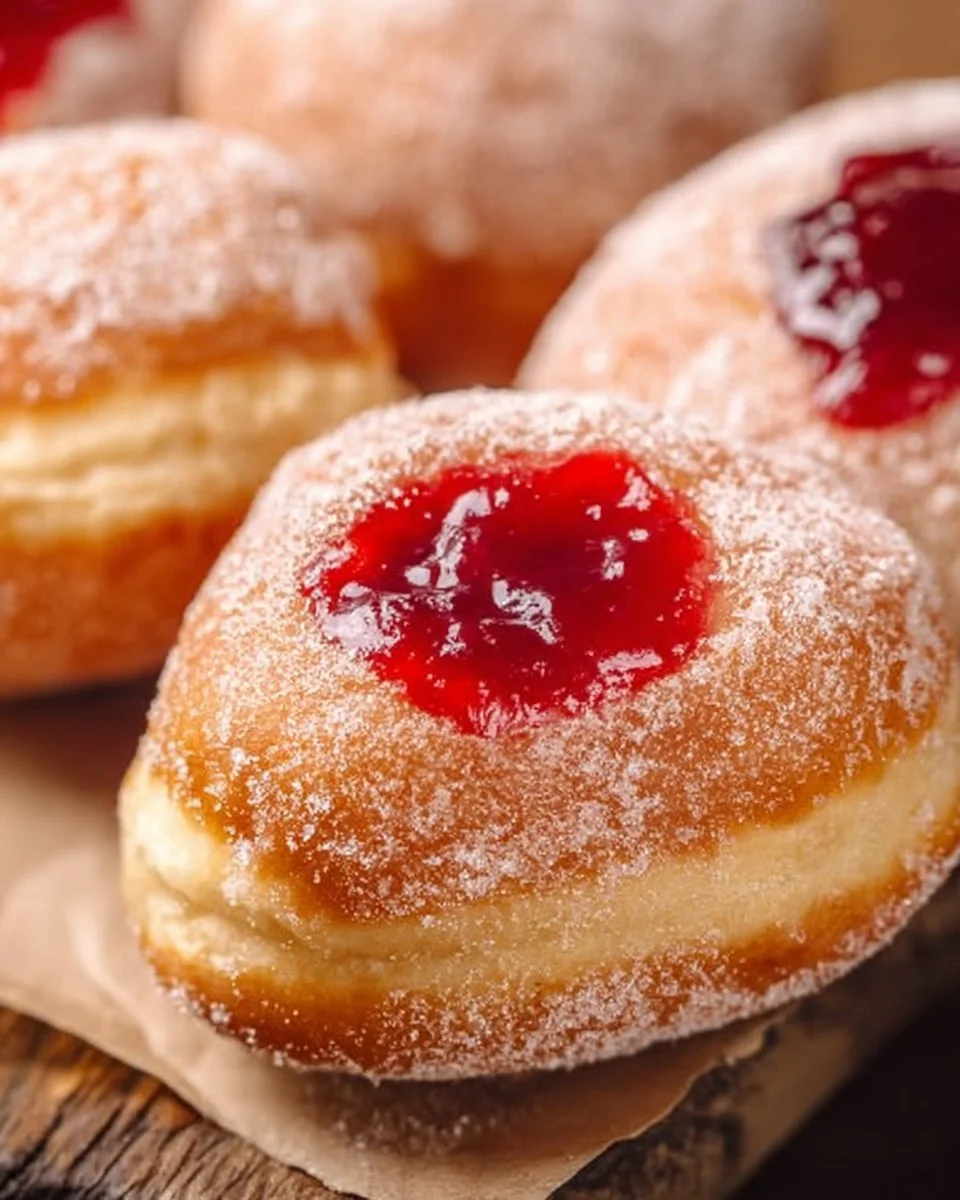
What Makes Homemade Jelly Donuts Special
Homemade Jelly Donuts are soft, pillowy fried dough filled with sweet jelly. They smell of warm butter and yeast. The exterior browns to a light golden color. Inside, the dough is tender and slightly chewy. A burst of fruit jam hits the palate with each bite. This mix of textures and flavors makes them irresistible. 🍩
These donuts trace their roots to many cultures. Variations appear in Eastern Europe, Germany (as Berliner), and in Jewish and American kitchens. Each region brings its own jam, sugar, or glazing. The result is a treat that feels both nostalgic and fresh.
People love this simple Homemade Jelly Donuts recipe for the scent of fresh frying dough and the surprise of jam inside. The flavors are adaptable. Use strawberry, raspberry, apricot, or any jam you love. The aroma of warm yeast, butter, and fried dough draws family and friends to the kitchen. If you like make-ahead treats, learn more about freezing baked goods with tips on how to freeze homemade brownies, which applies to many batch-baking ideas.
This introduction will make you excited to try an easy Homemade Jelly Donuts batch today. The recipe below is designed to be beginner-friendly and rewarding.
Why This Recipe is Perfect
- Quick and easy: Uses one rise and simple shaping.
- Pantry-friendly: Most ingredients are common in kitchens.
- Budget-friendly: Uses basic staples without expensive tools.
- Beginner-friendly: Clear steps help new bakers succeed.
- Family-approved: Kids love filling and decorating.
- Reliable texture: Balanced flour, fat, and yeast create soft crumb.
- Flavor-flexible: Any jam or jam alternative will work.
This version is better than many online recipes because it focuses on clear steps, realistic timing, and practical tips for frying. It avoids overproofed dough and gives guidance on filling and frying temperature for consistent results.
How to Make Homemade Jelly Donuts
This overview explains the logic behind each step. Start by proofing the yeast in warm milk to confirm activity. Mixing dry ingredients next ensures even distribution of sugar and salt. Adding melted butter and an egg enriches the dough and makes it tender. Kneading develops gluten so donuts hold their shape but stay soft. A single rise doubles volume and builds flavor. Rolling to 1/2 inch gives the right balance of fluffy interior and structure for frying. Filling before frying helps seal in flavor and prevents soggy centers. Frying at 350°F (175°C) creates a golden crust quickly without overcooking the inside. Cooling briefly and dusting with powdered sugar completes the classic look.
Key temperature and texture cues:
- Milk should feel warm, not hot (about 100–110°F).
- Dough should be slightly tacky but smooth after kneading.
- When rolled to 1/2 inch, the dough holds shape but gives when pressed lightly.
- Oil must stay at steady 350°F to brown evenly.
Include the following tips while cooking:
- Use a candy or instant-read thermometer for oil.
- Fry in small batches to keep oil temperature stable.
- Drain on paper towels and finish with powdered sugar while slightly warm.
Ingredients
- 2 cups all-purpose flour
- 1/4 cup granulated sugar
- 1 packet active dry yeast (about 2 1/4 teaspoons)
- 1/2 cup warm milk
- 1/4 cup butter, melted
- 1 large egg
- 1/2 teaspoon salt
- Vegetable oil for frying
- 1 cup jelly or jam of your choice
- 1/4 cup powdered sugar
How to choose high-quality ingredients:
- Flour: Use fresh all-purpose flour stored in a cool, dry place.
- Yeast: Check the expiration date. Proof it in warm milk to confirm activity.
- Butter: Unsalted is best so you can control salt levels.
- Jam: Choose a thick, high-fruit-content jam to avoid runny fillings.
Substitutions for dietary needs:
- Dairy-free: Use plant milk and vegan butter substitute for homemade or vegan jelly donuts.
- Egg-free: Replace the egg with a flax “egg” (1 tbsp ground flax + 3 tbsp water) for a binder.
- Gluten-free: Use a 1:1 gluten-free flour blend, but expect denser texture and adjust kneading carefully.
Try a classic baking swap or test small batches when using substitutes.
Also, if you enjoy other classic baked treats, try our classic banana bread recipe for another simple homemade favorite.
Step-by-Step Directions
-
Proof the yeast.
- Visual cue: Milk will look frothy and bubbly after about 5 minutes.
- Smell: Slight yeasty aroma.
- Mistake to avoid: Milk that’s too hot will kill yeast. Aim for warm, not scorching.
-
Mix dry ingredients.
- Combine flour, granulated sugar, and salt in a large bowl.
- Visual cue: Even color and no clumps.
- Mistake to avoid: Forgetting salt will yield flat-tasting donuts.
-
Combine wet and dry.
- Add the yeast mixture, melted butter, and egg. Mix until a shaggy dough forms.
- Visual cue: Dough pulls together but may be slightly sticky.
- Smell: Rich butter and egg scent.
- Mistake to avoid: Overmixing or underhydrating. Adjust with a tablespoon of flour or milk as needed.
-
Knead the dough.
- On a floured surface, knead 5–10 minutes until smooth and elastic.
- Visual cue: Dough becomes shiny and springs back when pressed.
- Sound: Minimal noise; gentle tapping is fine.
- Mistake to avoid: Adding too much flour. Dough should be slightly tacky.
-
First rise.
- Place in a greased bowl, cover, and let rise in a warm spot about 1 hour or until doubled.
- Visual cue: Dough doubles and leaves a slight indentation when poked.
- Mistake to avoid: Overproofing makes donuts flat when fried.
-
Shape and fill.
- Punch down, roll to 1/2 inch thickness, and cut rounds. Place a small spoonful of jelly on half the rounds, then top with another round and press edges to seal.
- Visual cue: Seams should be pinched closed.
- Smell: Jam scent will be noticeable.
- Mistake to avoid: Overfilling leads to leakage.
-
Heat oil.
- Heat oil to 350°F (175°C). Use a deep pan and enough oil for donuts to float.
- Visual cue: Small wisps of steam and steady thermometer reading.
- Mistake to avoid: Oil too hot will burn outsides before inside cooks.
-
Fry donuts.
- Fry 2–3 minutes per side until golden brown. Flip gently with a slotted spoon.
- Visual cue: Even golden color.
- Sound: Gentle bubbling that slows slightly when donuts are nearly done.
- Mistake to avoid: Crowding the pan drops oil temperature.
-
Drain and finish.
- Remove to paper towels, then roll in powdered sugar while still slightly warm.
- Visual cue: Sugar adheres to warm surface.
- Mistake to avoid: Using hot donuts straight from oil will dissolve powdered sugar.
-
Serve and enjoy.
- Let cool slightly then serve warm for the best texture and flavor.
For a savory pairing idea, try serving alongside the crisp notes of a crispy dill chicken sandwich with homemade aioli for a playful contrast.
How to Serve Homemade Jelly Donuts
- Classic: Serve warm with a dusting of powdered sugar and a side of extra jam for dipping.
- Brunch board: Arrange donuts with fresh fruit, whipped cream, and coffee for a crowd-pleasing display.
- Beverage pairings: Serve with hot coffee, café au lait, tea, or a chilled glass of milk.
- Plating tips: Stack two donuts on a small dessert plate, sprinkle with sugar, and add a mint sprig for color.
Serving warm highlights the soft texture and fluid jam center. For a festive touch, pipe a small star of jam on top.
Storage and Reheating
- Short-term: Store in an airtight container at room temperature for up to 2 days. Donuts will lose some crispness but remain tasty.
- Fridge: Refrigerate for up to 4 days. Bring to room temperature before reheating.
- Freezer: Freeze uncoated donuts in a single layer on a baking sheet until solid, then transfer to a freezer bag for up to 2 months. Thaw in the fridge overnight.
Best reheating practices:
- Oven: Preheat to 350°F, bake donuts 5–7 minutes to restore texture.
- Microwave: Short bursts (10–15 seconds) warm the donut but may make it slightly soggy. Use only if you’ll eat it immediately.
- Air fryer: 325°F for 2–3 minutes crisps the exterior without drying the interior.
Reheating in the oven or air fryer gives the best texture.
Pro Tips
- Use a thermometer for oil. Accurate temperature prevents greasy or raw donuts.
- Don’t overfill with jelly. Use about 1 teaspoon to 1 tablespoon depending on dough size.
- Keep dough slightly tacky. Over-flouring makes the crumb heavy.
- Fry in small batches. This keeps oil hot and produces even browning.
- Use thick jam. Thin preserves can leak during frying.
- Finish with powdered sugar while donuts are warm to help it stick.
- Test one donut first. Adjust time and temperature before frying the whole batch.
Variations
- Spicy version: Add a pinch of cinnamon and cayenne to the dough for warm heat. Pair with chili-infused jam.
- Healthy-ish version: Bake instead of fry. Brush with melted butter and finish with a cinnamon-sugar mix. Texture will be different but still delicious.
- Vegan option: Use plant milk, vegan butter, and a flax egg. Fry the same way. Use jam free from gelatin.
- Deluxe gourmet: Use pastry cream and whole-fruit compote. Finish with a light glaze and edible flowers.
These swaps let you tailor the recipe to taste and dietary needs.
Frequently Asked Questions (FAQ)
Q: Can I prep these donuts ahead of time?
A: Yes. Prepare dough, let it rise, then refrigerate overnight. Bring to room temperature, roll, cut, and fry the next day. You can also freeze shaped, un-fried rounds and fry from thawed.
Q: Why is my dough dense?
A: Dense dough often means under-kneading or too much flour. Knead until elastic and slightly tacky. Check yeast freshness and allow enough rise time.
Q: My jelly oozes out when frying. What went wrong?
A: Overfilling or weak seals cause leakage. Use less jam and press edges firmly. Chill filled donuts briefly before frying to help seal.
Q: How long should the oil stay at 350°F?
A: Maintain 350°F for consistent browning. If oil drops, pause between batches to let it recover.
Q: Can I bake these instead of frying?
A: Yes, but expect a different texture. Bake at 375°F for about 12–15 minutes, brush with butter, and add sugar.
Q: What thickness should I roll the dough to?
A: About 1/2 inch is ideal. This gives a fluffy interior and sturdy shape for frying.
Q: How do I keep donuts from getting greasy?
A: Keep oil at correct temperature, avoid overcrowding, and drain properly on paper towels.
(For schema-rich snippet optimization, you can convert these Q/A pairs into structured FAQ markup on your page.)
Conclusion
I hope this simple Homemade Jelly Donuts guide helps you make the best Homemade Jelly Donuts at home. Try the clear steps and tips above for consistent, delicious results. For more inspiration and alternative takes, check out a detailed Bakers Royale jelly-filled doughnut recipe and a creative guide to stuffed donuts from Chef Lindsey Farr.
If you enjoyed this recipe, save it, share it, and try one of the variations for your next batch.
Print
Homemade Jelly Donuts
- Total Time: 45 minutes
- Yield: 12 servings
- Diet: Vegetarian
Description
Soft, pillowy fried dough filled with sweet jelly, these homemade jelly donuts are a delightful treat bursting with flavor.
Ingredients
- 2 cups all-purpose flour
- 1/4 cup granulated sugar
- 1 packet active dry yeast (about 2 1/4 teaspoons)
- 1/2 cup warm milk
- 1/4 cup butter, melted
- 1 large egg
- 1/2 teaspoon salt
- Vegetable oil for frying
- 1 cup jelly or jam of your choice
- 1/4 cup powdered sugar
Instructions
- Proof the yeast by mixing it with warm milk for about 5 minutes until frothy.
- Mix dry ingredients in a large bowl – flour, sugar, and salt.
- Combine wet and dry ingredients, adding yeast mixture, melted butter, and egg until a shaggy dough forms.
- Knead the dough on a floured surface for 5-10 minutes until smooth and elastic.
- Let the dough rise in a greased bowl for about 1 hour or until doubled in size.
- Shape and fill the donuts by rolling out the dough, cutting rounds, placing jelly on half, and sealing with another round.
- Heat vegetable oil to 350°F (175°C) in a deep pan.
- Fry donuts for 2-3 minutes per side until golden brown.
- Remove and drain on paper towels, then roll in powdered sugar while warm.
- Serve and enjoy warm for the best texture.
Notes
Fry in small batches to keep oil temperature stable and avoid overfilling to prevent leakage.
- Prep Time: 30 minutes
- Cook Time: 15 minutes
- Category: Dessert
- Method: Frying
- Cuisine: American
Nutrition
- Serving Size: 1 donut
- Calories: 210
- Sugar: 6g
- Sodium: 150mg
- Fat: 8g
- Saturated Fat: 3g
- Unsaturated Fat: 4g
- Trans Fat: 0g
- Carbohydrates: 28g
- Fiber: 1g
- Protein: 3g
- Cholesterol: 35mg
Keywords: jelly donuts, homemade donuts, dessert recipes