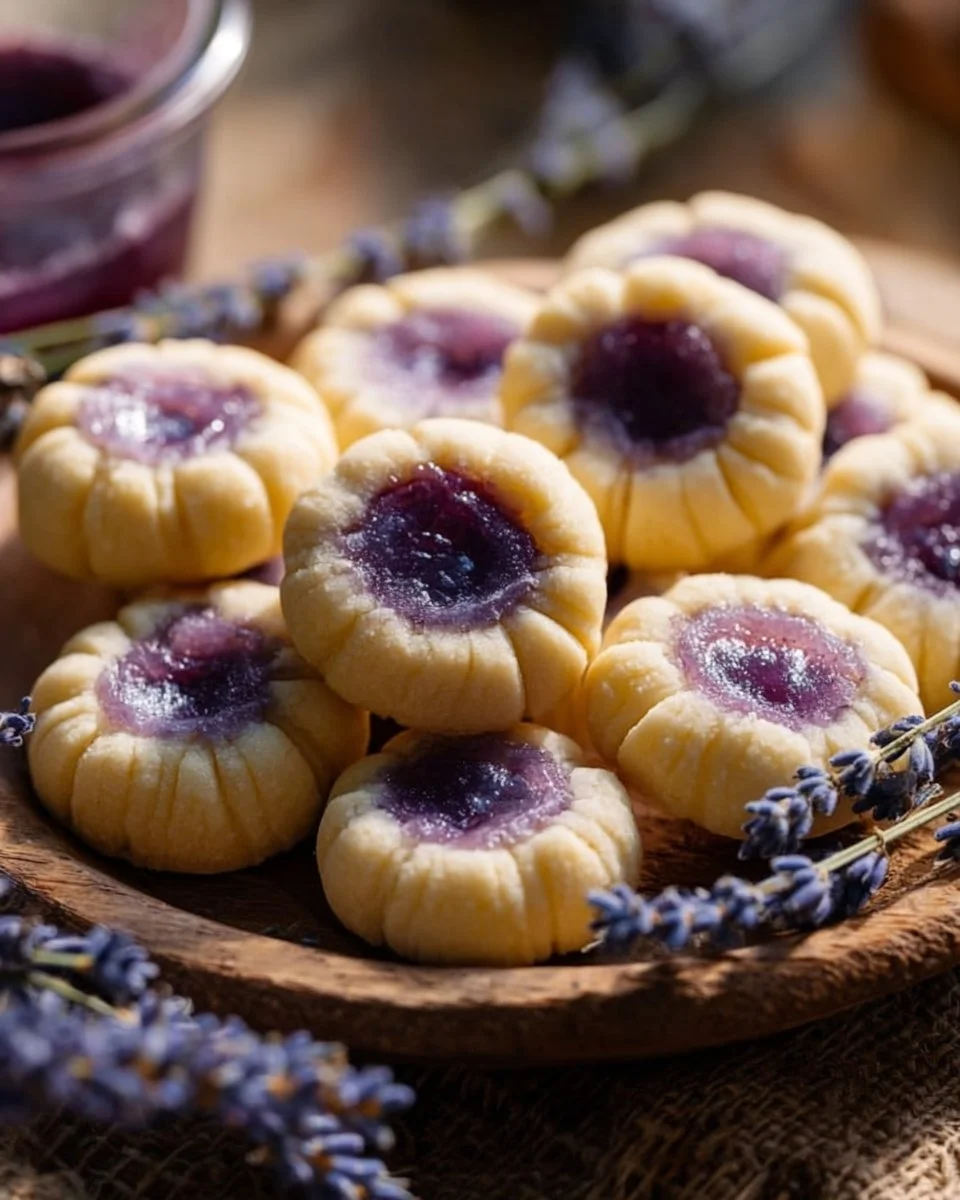
These lemon lavender thumbprint cookies are a bright, floral twist on a classic cookie. They trace their roots to thumbprint cookies that began in European kitchens as small butter rounds pressed with a thumb and filled with jam. The lemon and lavender version blends sunny citrus with soft floral notes. When you bake them the house fills with a clean lemon scent and a gentle lavender perfume. The cookie itself has a tender, crumbly texture from butter and sugar, and the small lemon curd center adds a burst of tang and glossy color. Each bite gives a buttery snap, a whisper of almond and vanilla, and a bright lemon pop that wakes the palate. The lavender adds a calm, elegant flavor that keeps the cookie from being too sweet. People love these cookies for tea time, gift boxes, and holiday trays because they look small, pretty, and deliberate. They are also easy to make in one batch and scale up for a crowd. This recipe uses simple pantry items, and the step by step method makes it friendly for new bakers. The cookie fits many occasions: spring brunch, bridal showers, or a quiet afternoon snack. Readers who enjoy short ingredient lists and clear steps will like this recipe. For a related lemon cookie that is chewier and fruitier, try chewy lemon raspberry cookies to compare textures and sweetness. You will feel truly proud handing these cookies to friends, and they will ask you for the recipe again next time soon.
Why make this recipe
- Simple ingredients: You need basic pantry items like flour, butter, sugar, and lemon curd. The short list makes shopping easy.
- Beginner friendly: The steps are clear. Pressing with your thumb and filling is low tech and forgiving for new bakers.
- Elegant flavor: The floral lavender lifts the lemon and makes these cookies feel special without extra work.
- Great for gifts and trays: They keep their shape and look polished on a cookie plate or in a small box.
- Scales well: You can double or triple the batch for parties without adding hard steps.
- Better than many versions: This recipe balances lavender so it never overwhelms, uses lemon curd for a glossy, bright center, and adds a touch of almond and vanilla for depth. It is time-saving because the dough comes together fast and uses lemon curd instead of making curd from scratch.
How to make Lemon Lavender Thumbprint Cookies
Start by creaming butter and powdered sugar. Creaming traps air in the butter and sugar mix. This air makes the cookie light rather than dense. When the mixture turns pale and fluffy, you know you have enough air. Add the vanilla and almond extract for flavor depth. The lemon juice adds a fresh tang and helps the dough bind.
The finely ground culinary lavender needs careful folding. You want even, light specks of lavender. If the lavender is too coarse it can taste bitter. Mixing it in with the wet ingredients spreads the floral note evenly.
Next, add the flour and salt slowly. The goal is a tender dough. Too much mixing builds gluten and makes cookies tough. Mix just until the dough forms and looks slightly crumbly but holds together when pressed.
Rolling dough into 1-inch balls gives even bake time. Use your thumb to make a modest indent; a deep cup will overfill with curd and thin the cookie edges. Fill with lemon curd just before baking so the curd keeps its glossy look.
Baking at 350°F sets the cookie edges and gives a soft center. Watch for light golden edges. Over-bake and you lose the tender texture. Let cool fully so the curd sets and the crumb firms.
For flavor practice, you can compare texture notes with other cookies like best double chocolate chip cookies to see how butter and mixing affect chew and spread.
Ingredients
- 1 1/2 tsp Culinary lavender, finely ground
- 1 tbsp Lemon juice
- 1/2 cup Lemon curd
- 2 cups All-purpose flour
- 1/4 tsp Almond extract
- 1/2 cup Powdered sugar
- 1/4 tsp Salt
- 1 tsp Vanilla extract
- 1 cup Unsalted butter
Choose the best items for a fresh taste. Use unsalted butter at room temperature for even creaming. Pick a good lemon curd that is thick and glossy; jarred curds from trusted brands work well. For culinary lavender use food-grade lavender and grind it fine to avoid floral grit. Use fresh lemon juice if you can; bottled lemon juice will work but may taste flatter. Choose all-purpose flour that you usually trust for baking.
Substitutions:
- Dairy-free: Use a high-quality vegan butter in a 1:1 swap and a dairy-free powdered sugar. The texture will be close but may spread slightly more.
- Gluten-free: Replace flour with a 1:1 gluten-free baking blend and add a small extra egg white or 1 tbsp cornstarch for structure.
- Sugar-free: Use powdered erythritol designed for baking, but expect a different texture and slightly less golden color.
Also see similar lemon curd cookie notes at ultimate luscious lemon curd cookies for curd choices and tips.
Directions
-
Preheat the oven to 350°F (175°C).
- Visual cue: Oven reaches temp and feels warm to the touch inside. Use an oven thermometer if unsure. A steady 350°F gives even browning.
-
In a large bowl, cream together the unsalted butter and powdered sugar until light and fluffy.
- Visual cue: The mix turns pale and slightly airy. It will smear softly on a spoon but hold shape. This takes about 2-4 minutes with a hand mixer.
-
Add in the vanilla extract, almond extract, lemon juice, and finely ground culinary lavender, mixing until combined.
- Smell cue: You should smell lemon and a faint floral note. The lavender should be present but not sharp.
-
Gradually add the flour and salt, and mix until the dough comes together.
- Visual cue: The dough will look slightly crumbly at first then hold together when pressed. Stop mixing when it forms a soft ball.
-
Roll the dough into 1-inch balls and place on a baking sheet lined with parchment paper.
- Visual cue: Balls should be even and smooth. Use a small cookie scoop for consistent size so all cookies bake the same.
-
Use your thumb to make an indent in the center of each ball.
- Visual cue: Press about halfway through the ball to leave a cup for curd. The edge should stay firm and not collapse.
-
Fill each indent with a small amount of lemon curd.
- Visual cue: Fill to the rim but not over. The curd should sit glossy and slightly domed. Too much curd will spill as it warms.
-
Bake for 12-15 minutes or until lightly golden.
- Visual cue: The cookie edge turns faint gold while centers stay pale. The bottom will be set. The cookie should feel slightly firm at the edge and soft in the center.
-
Allow to cool before serving.
- Visual cue: The lemon curd will set and become glossy. The cookie texture firms as it cools. Move to a rack after 5 minutes to finish cooling.
How to serve Lemon Lavender Thumbprint Cookies
- Tea service: Serve on a simple white plate with small sprigs of lavender. Pair with Earl Grey or chamomile tea for matching floral notes.
- Dessert plate: Arrange three cookies on a small dessert plate with a dusting of powdered sugar and a lemon wedge for color. Pair with a light prosecco or sparkling wine for a party.
- Coffee break: Serve with a mild roast coffee. The floral and citrus flavors make a gentle contrast to roasted coffee notes.
- Gift box: Stack in parchment in a small box with a ribbon. Add a note that they contain lavender and lemon.
Plating tip: Use even spacing and a small garnish like lemon zest curls or a tiny lavender sprig for a professional look.
How to store Lemon Lavender Thumbprint Cookies
Short term (room/F fridge): Store in an airtight container at room temperature for up to 3 days. If your kitchen is warm, store in the fridge to keep the curd firm. Place parchment between layers so they don’t stick.
Long term (freezer): Freeze unbaked dough balls on a tray until firm, then transfer to a freezer bag for up to 3 months. Bake from frozen adding 2-3 minutes to baking time. You can also freeze baked cookies in a single layer wrapped in plastic, then sealed in a freezer bag for up to 2 months.
Best reheating method: Warm baked cookies for 5-8 seconds in a microwave on low just to take the chill off. For a crisp edge, reheat in a 300°F oven for 3-5 minutes. Avoid long reheats or high heat or the curd may weep and the cookie may dry.
Tips to make Lemon Lavender Thumbprint Cookies
- Use room temperature butter for easy creaming. Cold butter won’t cream well; melted butter makes cookies too flat.
- Grind lavender fine. Use a spice grinder and taste one pinch raw before adding to ensure it is not too strong.
- Don’t overmix after adding flour. Mix until just combined to keep cookies tender.
- Keep indent depth even. Press with the pad of your thumb once, then smooth with the back of a small spoon if needed.
- Fill just to the rim with curd. Too much will spill and thin edges will over-brown.
- Chill dough briefly if it feels too soft. A 15-20 minute chill firms the dough and prevents excessive spread.
- Test bake one cookie first if you change size. This helps set oven time and prevents burned batches.
Variation
- The Classic Raspberry: Replace lemon curd with raspberry jam. Add a tiny drop of lemon juice to jam for brightness.
- The Honey-Lavender: Swap lemon curd for a spoon of honey or lavender-infused honey. Reduce added lemon juice in dough to keep balance.
- The Almond Blossom: Increase almond extract to 1/2 tsp and top curd with a slivered almond for crunch.
- The Chocolate Kiss: After baking, press a small chocolate piece into the warm curd for a lemon-chocolate contrast.
- The Gluten-Free Version: Use a cup-for-cup gluten-free flour blend plus 1 tbsp cornstarch for better crumb.
FAQs
Q: Can I make the dough ahead of time?
A: Yes. You can make dough, shape into balls, press indents, and freeze on the tray. Once frozen, move to a bag. Bake from frozen, adding 2-3 minutes to time.
Q: Why is my dough crumbly and will not stick together?
A: You may have added too much flour or not mixed wet ingredients enough. Add a teaspoon of lemon juice or a tiny dot of softened butter and press to bind. Mix gently.
Q: Why does the lavender taste so strong and bitter?
A: That means the lavender is coarse or you used too much. Use culinary-grade lavender and grind it finely. Reduce to 1 tsp if sensitive.
Q: Can I use homemade lemon curd?
A: Yes. Homemade curd is lovely and often less sweet. Ensure it is thick and cooled before filling to avoid runniness.
Q: My curd weeps after baking. How can I stop that?
A: Do not overfill the cups. Chill cookies briefly before baking and avoid overbaking. Also let cookies cool fully on a rack; condensation can make curd thin.
Q: Can I use a different citrus like lime or orange?
A: Yes. Use the same amount of juice and curd. Taste the dough before baking to adjust sweetness if needed.
Conclusion
If you want a different take or more ideas for lemon and lavender cookies, see this inspired version at Lavender Lemon Curd Cookies from EmilyFabulous for extra notes on curd and floral balance. For a professional baker’s take and a tested thumbprint method, you can read Sheri Silver’s lemon lavender thumbprint cookies for more tips on texture and timing.
Print
Lemon Lavender Thumbprint Cookies
- Total Time: 30 minutes
- Yield: 24 cookies
- Diet: Vegetarian
Description
These lemon lavender thumbprint cookies combine sunny citrus with soft floral notes for a delightful treat perfect for any occasion.
Ingredients
- 1 1/2 tsp Culinary lavender, finely ground
- 1 tbsp Lemon juice
- 1/2 cup Lemon curd
- 2 cups All-purpose flour
- 1/4 tsp Almond extract
- 1/2 cup Powdered sugar
- 1/4 tsp Salt
- 1 tsp Vanilla extract
- 1 cup Unsalted butter
Instructions
- Preheat the oven to 350°F (175°C).
- Cream together the unsalted butter and powdered sugar until light and fluffy.
- Add in the vanilla extract, almond extract, lemon juice, and finely ground culinary lavender, mixing until combined.
- Gradually add the flour and salt, and mix until the dough comes together.
- Roll the dough into 1-inch balls and place on a baking sheet lined with parchment paper.
- Use your thumb to make an indent in the center of each ball.
- Fill each indent with a small amount of lemon curd.
- Bake for 12-15 minutes or until lightly golden.
- Allow to cool before serving.
Notes
Use room temperature butter for easy creaming; chill dough briefly if it feels too soft.
- Prep Time: 15 minutes
- Cook Time: 15 minutes
- Category: Dessert
- Method: Baking
- Cuisine: American
Nutrition
- Serving Size: 1 cookie
- Calories: 120
- Sugar: 9g
- Sodium: 60mg
- Fat: 8g
- Saturated Fat: 5g
- Unsaturated Fat: 3g
- Trans Fat: 0g
- Carbohydrates: 12g
- Fiber: 0g
- Protein: 1g
- Cholesterol: 30mg
Keywords: cookies, lemon, lavender, thumbprint, dessert, baking